

Description
- Description
- Specs
- Labels and SDS Forms
Heritage Fungicide
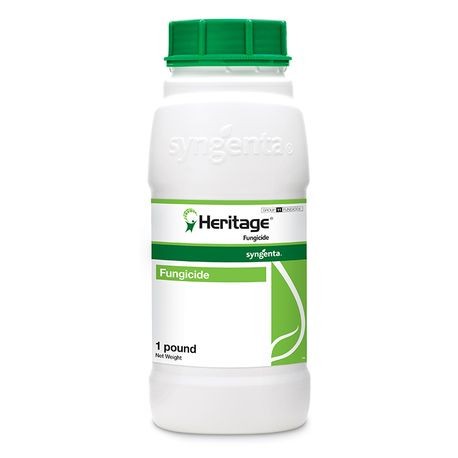
Heritage Fungicide is a broad-spectrum systemic fungicide powered by azoxystrobin for prevention and control of important diseases in turf, ornamentals, greenhouses, nurseries, hydroponic production, landscape areas, and transplants of fruit, nut, vegetable, and herb plants. As a Group 11 strobilurin fungicide, Heritage provides long-lasting preventive disease control with systemic movement through treated plants.
Heritage may be applied as a foliar spray, drench, soil broadcast, banded spray, or through labeled sprinkler, drip, and micro-irrigation systems. It controls a wide range of foliar, stem, crown, and root diseases including brown patch, anthracnose, gray leaf spot, Pythium blight, Pythium root rot, powdery mildew, downy mildew, rusts, leaf spots, flower blights, Rhizoctonia diseases, and other listed diseases.
Features & Benefits
✓ Broad-spectrum azoxystrobin fungicide for turf, ornamentals, greenhouses, nurseries, landscapes, and transplant production
✓ Systemic xylem-mobile activity helps move protection through plant tissue, including canopy and new growth
✓ Preventive and curative properties help protect against listed foliar, stem, crown, and root diseases
✓ Controls major turf diseases including brown patch, anthracnose, gray leaf spot, Pythium blight, Pythium root rot, summer patch, take-all patch, snow molds, leaf spot, and rusts
✓ Controls more than 33 ornamental diseases across major pathogen groups including Oomycetes, Ascomycetes, Basidiomycetes, and Deuteromycetes
✓ Flexible application options include foliar spray, drench, soil broadcast, banded applications, in-furrow use, and labeled chemigation systems
✓ Useful in rotation programs with non-Group 11 fungicides for resistance management
✓ 4-hour REI supports practical use in professional greenhouse, nursery, turf, and ornamental production programs
Labeled Use Sites
Heritage Fungicide is labeled for prevention and control of diseases in turf produced on sod farms, turf on golf courses, lawns, landscape areas around residential, institutional, public, commercial, and industrial buildings, parks, recreational areas, athletic fields, ornamentals, greenhouses, shade houses, lath houses, outdoor nurseries, retail nurseries, interiorscapes, commercial landscape areas, conifers, Christmas trees, commercial rose production, hydroponic systems, and transplants of fruit, nut, vegetable, and herb plants.
Target Diseases
Heritage Fungicide controls many turf diseases including anthracnose, bermudagrass decline, brown patch, brown ring patch, cool weather brown patch, yellow patch, fairy ring, Fusarium patch, gray leaf spot, gray snow mold, Typhula blight, leaf and sheath spot, leaf rust, stem rust, stripe rust, leaf spot, melting out, necrotic ring spot, pink patch, pink snow mold, powdery mildew, Pythium blight, Pythium root rot, Pythium root dysfunction, red thread, Rhizoctonia large patch, southern blight, summer patch, take-all patch, and Zoysia patch.
In ornamentals and plant production, Heritage controls or suppresses listed diseases including Phomopsis blight, tip blight, Alternaria leaf spot, anthracnose, Cercospora leaf spot, Cylindrocladium leaf spot and stem canker, downy mildew, Entomosporium leaf spot, iris leaf spot, rose blackspot, Myrothecium leaf spot, scab, Marssonina leaf spot, powdery mildew, needle rust, other rusts, flower blights, Botrytis blight suppression, aerial/shoot blight, Fusarium species, Rhizoctonia solani, Sclerotium rolfsii, Sclerotinia species, and Pythium suppression.
Application Notes
Apply Heritage Fungicide prior to disease development for best results. For turf applications, mix Heritage with the required amount of water and apply as a dilute spray in 2 to 4 gallons of water per 1,000 square feet. For spot treatments, the label lists 0.2 ounce of Heritage Fungicide per 1 to 2 gallons of water. Application intervals and rates vary by disease, pressure, and site.
For ornamentals, Heritage may be applied as a foliar or soil broadcast, drench, or banded spray targeted at the foliage or crown of the plant. Good coverage and wetting of foliage are necessary for best control. Use Heritage as part of a resistance-management program and do not rely repeatedly on Group 11 fungicides without rotating to a fungicide with a different mode of action.
Product Information
Active Ingredient: Azoxystrobin 50%
FRAC Group: Group 11 Fungicide
Chemical Family: Strobilurin / QoI Inhibitor
Formulation: Water-Dispersible Granule (WG)
EPA Reg. No.: 100-1093
Signal Word: Caution
Manufacturer: Syngenta Crop Protection, LLC
Package Size: 1 lb
Use Sites: Turf, ornamentals, greenhouses, shade houses, nurseries, landscapes, conifers, Christmas trees, commercial roses, hydroponic systems, and fruit, nut, vegetable, and herb transplants
Recommended Rotation Partner: A labeled fungicide from a different FRAC group. The Heritage label states not to alternate with other strobilurin fungicides such as pyraclostrobin or trifloxystrobin, and the sell sheet recommends rotation with products such as Micora and Subdue Maxx as part of a total disease management program.
Recommended Surfactant: No general surfactant recommendation found on the turf label. For ornamentals, the label states that an adjuvant may enhance coverage on hard-to-wet foliage when appropriate; avoid silicone-containing adjuvants where the label warns of phytotoxicity risk.
| ACTIVE INGREDIENT | Azoxystrobin 50% |
| MANUFACTURER | Syngenta |
| EPA REGISTRATION | 100-1093 |
| NOT FOR SALE TO | VT (Restricted To Licensed Applicators Only) |
| COMPARABLE PRODUCTS | Estate |
Payment & Security
Your payment information is processed securely. We do not store credit card details nor have access to your credit card information.
