

Description
- Description
- Specs
- Labels and SDS Forms
Strobe 50WG Broad Spectrum Fungicide
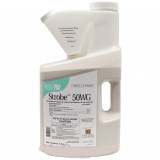
Strobe 50WG is a professional broad-spectrum systemic fungicide containing 50% azoxystrobin for preventative and curative management of numerous turf and ornamental diseases. Its FRAC Group 11 strobilurin chemistry inhibits mitochondrial respiration in susceptible fungi while systemic uptake through plant leaves, crowns, and roots provides protection against foliar, stem, crown, and root diseases.
Strobe 50WG provides the same active ingredient concentration and WG formulation profile as Heritage® Fungicide, making it a cost-effective generic alternative for professional disease-management programs. It is labeled for turf, golf courses, lawns, athletic fields, parks, landscapes, greenhouses, nurseries, ornamentals, conifers, Christmas trees, and commercial rose production, with flexible foliar, soil-injection, drench, and chemigation applications where specifically labeled.
Features & Benefits
✓ Contains 50% azoxystrobin with professional FRAC Group 11 strobilurin chemistry
✓ Broad-spectrum preventative fungicide with systemic and curative properties
✓ Absorbed through plant leaves, crowns, and roots for systemic disease protection
✓ Controls major turf diseases including brown patch, anthracnose, Pythium, gray leaf spot, summer patch, take-all patch, snow mold, and more
✓ Extensive ornamental disease spectrum includes leaf spots, blights, mildew, rusts, soil-borne diseases, and conifer diseases
✓ Flexible application by foliar spray, soil injection, drench, drip irrigation, or labeled chemigation programs
✓ Compatible with many commonly used fungicides and other crop-protection products for resistance-management programs when tank-mix compatibility is confirmed
Labeled Use Sites
Strobe 50WG is labeled for turf on golf courses, lawns, landscape areas around residential, institutional, public, commercial, and industrial buildings, parks, recreational areas, and athletic fields. It may also be used on container, bench, flat, plug, bed, and field-grown ornamentals in greenhouses, shade houses, outdoor nurseries, retail nurseries, and landscape areas.
Additional labeled programs include production and landscape conifers including Christmas trees, commercial rose production, and numerous ornamental trees, shrubs, flowers, groundcovers, and other labeled plants. Turf establishment uses include applications before or after seeding and during germination and emergence of ryegrass, bentgrass, bluegrass, and fescue turf types.
Target Diseases
Turf Diseases: Anthracnose, brown patch, cool-weather brown patch or yellow patch, fairy ring, Fusarium patch, gray leaf spot, gray snow mold or Typhula blight, leaf rust, stem rust, stripe rust, Bipolaris leaf spot, melting out, necrotic ring spot, pink patch, pink snow mold, powdery mildew, Pythium blight, Pythium root rot, red thread, Rhizoctonia large patch, southern blight, spring dead spot, summer patch, take-all patch, and zoysia patch.
Ornamental Diseases: Phomopsis blight, Sirococcus tip blight, Alternaria leaf spot, anthracnose, downy mildew of rose, Entomosporium leaf spot, iris leaf spot, Cladosporium leaf spot, rose blackspot, Myrothecium leaf spot, downy mildew of bedding plants, crabapple scab on tolerant varieties, Marssonina leaf spot, Cercospora leaf spot, powdery mildew caused by Erysiphe, Microsphaera, and Sphaerotheca species, needle rust, Phragmidium rust, Puccinia rust, Gymnosporangium rust, flower anthracnose, aerial or shoot blight caused by Phytophthora, and soil-borne Rhizoctonia, Sclerotium, and Fusarium diseases. Botrytis flower blight is labeled for suppression only.
Conifers & Commercial Roses: Conifer targets include Diplodia tip blight, Lophodermium needlecast, and Swiss needlecast. Commercial rose targets include downy mildew, powdery mildew, Phragmidium rust, Septoria leaf spot, and Alternaria leaf spot.
Application Notes
For most turf diseases, apply 0.2 to 0.4 oz of Strobe 50WG per 1,000 sq ft in 2 to 4 gallons of water per 1,000 sq ft at disease-specific intervals generally ranging from 14 to 28 days. Pythium blight and Pythium root rot use 0.4 oz per 1,000 sq ft on a 10- to 14-day interval. Gray and pink snow mold programs may use a single 0.7 oz per 1,000 sq ft application or two 0.4 oz applications according to label directions. Do not exceed 10 lb of product per acre per year on turf.
For ornamentals, general foliar rates are typically 1 to 4 oz per 100 gallons every 7 to 28 days, although individual diseases have specific rates and intervals. Strobe 50WG performs best as part of a preventative disease-management program. Do not rely on it as a universal late rescue treatment. Follow FRAC Group 11 resistance-management directions and rotate or tank mix with fungicides having different modes of action as directed by the label.
Product Information
Active Ingredient: Azoxystrobin 50%
Mode of Action: QoI fungicide that inhibits the quinone-outside site of mitochondrial electron transport and respiration
FRAC Group: 11
Chemical Family: Strobilurin / QoI
Resistance Management: Single-site chemistry; rotate or tank mix with fungicides having different modes of action according to label directions
Formulation: Wettable Granule (WG)
EPA Reg. No.: 53883-343
Manufacturer: Control Solutions, Inc. / Quali-Pro
Signal Word: CAUTION
Brand: Strobe 50WG
Generic For: Heritage Fungicide
Recommended Surfactant: Fairy ring applications require a labeled wetting agent such as Flash Wett. For ornamentals, a non-silicone wetter-sticker such as Prosurf 90 may enhance coverage on difficult-to-wet foliage; do not use silicone-based adjuvants because of phytotoxicity concerns.
| ACTIVE INGREDIENT | Azoxystrobin WG 50% |
| UPC | 072693000346 |
| MANUFACTURER | Quali Pro |
| EPA REGISTRATION | 53883-343 |
| NOT FOR SALE TO | AK |
| COMPARABLE PRODUCTS | Heritage |
Payment & Security
Your payment information is processed securely. We do not store credit card details nor have access to your credit card information.
