


Description
- Description
- Specs
- Labels and SDS Forms
Trip Triclopyr Herbicide
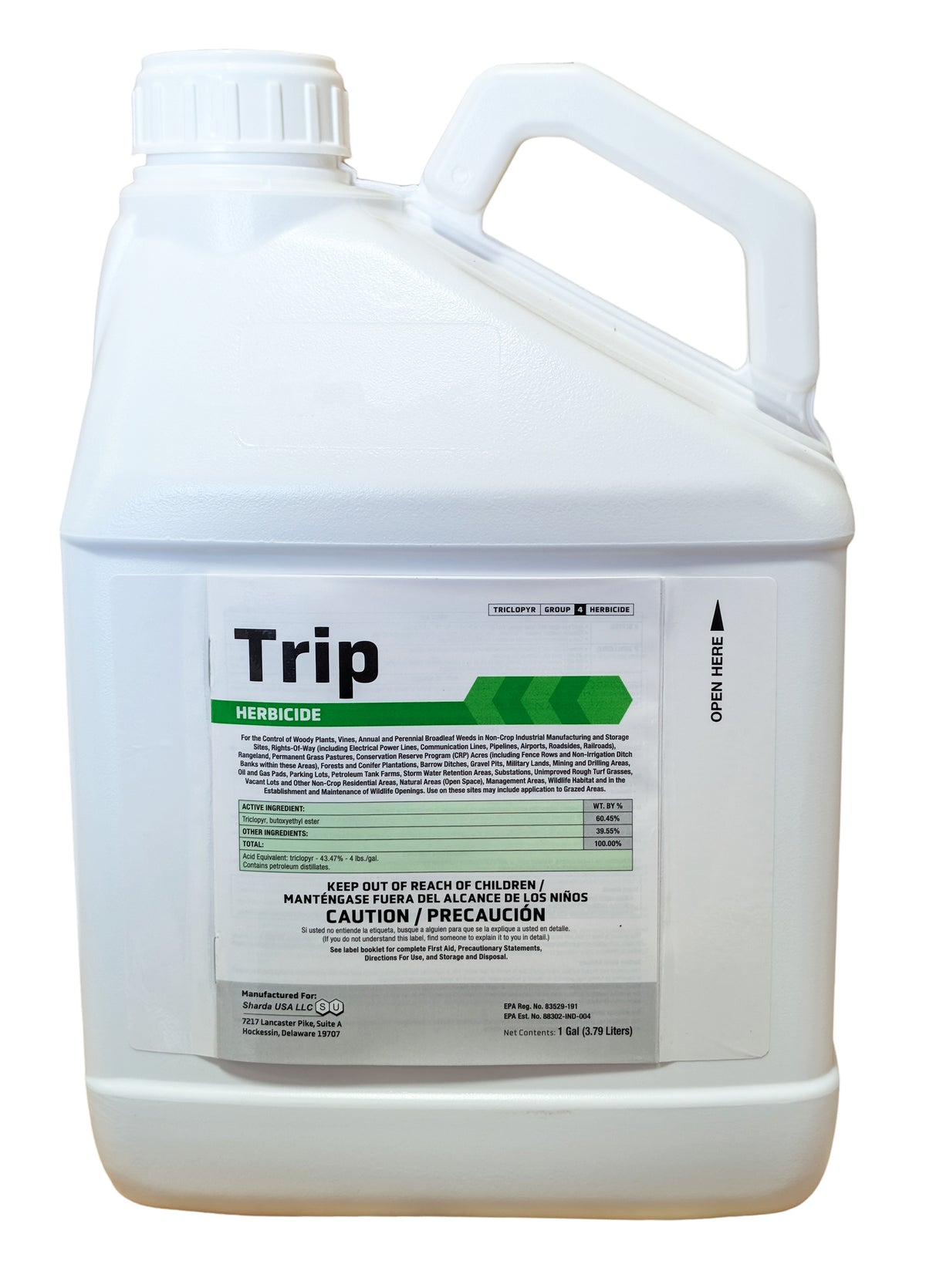
Trip is a professional systemic brush and broadleaf herbicide containing 60.45% triclopyr butoxyethyl ester, equivalent to 4 lb triclopyr acid equivalent per gallon. Its Group 4 synthetic auxin activity provides selective control of difficult woody plants, vines, brush, and annual and perennial broadleaf weeds in pasture, rangeland, rights-of-way, forestry, CRP acres, wildlife habitat, industrial sites, and other labeled non-crop areas.
Comparable to Garlon 4 Ultra and Remedy Ultra, Trip offers exceptional application flexibility for professional vegetation management. It may be applied as a broadcast or directed foliar spray, high- or low-volume brush treatment, basal bark treatment, low-volume basal treatment, dormant stem treatment, cut stump treatment, or labeled aerial application. Trip is especially useful where woody vegetation and invasive broadleaf weeds must be controlled while maintaining desirable established grasses.
Features & Benefits
✓ Contains 60.45% triclopyr butoxyethyl ester with 4 lb triclopyr acid equivalent per gallon
✓ Group 4 synthetic auxin herbicide for systemic control of woody plants, vines, and broadleaf weeds
✓ Controls or suppresses an extensive spectrum of brush species including blackberry, kudzu, salt cedar, tree-of-heaven, poison ivy, poison oak, oak, maple, and willow
✓ Flexible foliar, basal bark, dormant stem, cut stump, broadcast, spot, and aerial application options
✓ Labeled for rangeland, permanent grass pasture, CRP, forestry, rights-of-way, wildlife habitat, and industrial vegetation management
✓ Selective to many established grasses when used according to label directions
✓ Generic alternative to Garlon and Remedy triclopyr ester herbicides for professional brush-management programs
Labeled Use Sites
Trip is labeled for use in non-crop industrial manufacturing and storage sites, electrical power-line rights-of-way, communication lines, pipelines, airports, roadsides, railroads, rangeland, permanent grass pastures, Conservation Reserve Program acres, fence rows, non-irrigation ditch banks, forests, conifer plantations, barrow ditches, gravel pits, military lands, mining and drilling areas, oil and gas pads, parking lots, petroleum tank farms, stormwater retention areas, substations, unimproved rough turfgrass, vacant lots, non-crop residential areas, natural open-space areas, campgrounds, parks, prairie-management areas, trails, trailheads, recreation areas, wildlife habitat, wildlife-management areas, and wildlife openings.
Forestry uses include site preparation, conifer release, understory brush management, and other labeled forest-management programs. Use on labeled pasture, rangeland, CRP, forestry, and rights-of-way sites may include grazed areas subject to the grazing, haying, annual-use-rate, and livestock restrictions on the product label. Trip must not be applied directly to open water or allowed to contact desirable broadleaf crops, ornamentals, flowers, grapes, vegetables, or other sensitive plants.
Target Weeds & Brush
Woody Plants & Vines: twisted acacia, alder, arrowwood, ash, aspen, bear clover or bearmat, beech, birch, blackberry, blackbrush, blackgum, boxelder, Brazilian pepper, buckthorn, cascara, Ceanothus, cherry, chokecherry, chinquapin, cottonwood, hawthorn, dogwood, Douglas fir, elderberry, elm, winged elm, gallberry, gorse, granjeno, guajillo, guava, hazel, hickory, huisache, hornbeam, kudzu, locust, madrone, sweetbay magnolia, maple, bigleaf or vine maple, milkweed vine, mulberry, oak, Osage orange, pepper vine, persimmon, pine, poison ivy, poison oak, poplar, tulip poplar, salmonberry, silver myrtle or saltbush, salt cedar, sassafras, Scotch broom, sumac, sweetgum, sycamore, tanoak, thimbleberry, tree-of-heaven, trumpet creeper, Virginia creeper, wax myrtle, wild rose, willow, and willow primrose.
Annual, Biennial & Perennial Broadleaf Weeds: creeping beggarweed, field bindweed, black medic, common burdock, chicory, sulfur cinquefoil, clover, curly dock, dandelion, dogfennel, goldenrod, ground ivy, kudzu, common lambsquarters, annual lespedeza, sericea lespedeza, prickly lettuce, purple loosestrife, matchweed, mustard, garlic mustard, plantain, common ragweed, western ragweed, Pennsylvania smartweed, bull thistle, Canada thistle, tropical soda apple, vetch, wild violet, wild carrot or Queen Anne’s lace, and yarrow.
Special Label Qualifications: field bindweed and dandelion are listed for top-growth control. Huisache is listed for suppression. For boxelder, bigleaf or vine maple, trumpet creeper, and Virginia creeper, the label indicates basal bark or cut stump treatment provides the best control. Some difficult woody species may require higher labeled rates, tank mixtures, or repeat applications.
Application Notes
Trip may be applied at 1 to 8 quarts per acre depending on target species, site, application method, and label restrictions, with higher rates generally used for woody plant control. Broadcast broadleaf weed treatments generally use 1 to 4 quarts per acre, while broadcast woody-plant treatments may use 4 to 8 quarts per acre on appropriate non-grazed sites. For best foliar performance, apply when weeds and woody plants are actively growing and use sufficient spray volume for complete and uniform coverage.
Basal bark applications to susceptible woody plants with stems less than 6 inches in basal diameter use Trip mixed with an appropriate basal oil and applied to the lower 12 to 15 inches of the stem. Low-volume basal bark, thinline, dormant stem, basal cut stump, and cut stump treatments are also labeled. Maximum annual rates and grazing restrictions vary by site: rangeland, permanent grass pasture, CRP, and areas where grazing or hay harvest occurs are generally limited to 2 quarts per acre per year; forestry sites are limited to 6 quarts per acre per year; other non-grazed non-crop sites may allow up to 8 quarts per acre per year. Always follow the site-specific rate and restriction section of the label.
Product Information
Active Ingredient: Triclopyr Butoxyethyl Ester 60.45%
Acid Equivalent: Triclopyr 43.47% - 4 lb ae/gal
Mode of Action: Synthetic auxin / auxin mimic disrupting normal plant growth
HRAC/WSSA Group: Group 4
Chemical Family: Pyridine Carboxylic Acid
Formulation: Emulsifiable Concentrate (EC)
Activity: Systemic
EPA Reg. No.: 83529-191
Manufacturer: Sharda USA LLC
Signal Word: CAUTION
Brand: Trip
Generic For / Comparable To: Garlon 4 Ultra and Remedy Ultra
Package Sizes: 1 quart, 1 gallon, 2.5 gallons, and 265 gallon tote manufacturer packaging
Recommended Surfactant: For foliar applications where a standard agricultural surfactant is used or required, ProSurf 90 is an appropriate nonionic surfactant. Basal bark and cut-stump applications require the oil or basal diluent specified by the label rather than a foliar surfactant.
| ACTIVE INGREDIENT | Triclopyr 60.45% |
| MANUFACTURER | Sharda USA |
| EPA REGISTRATION | 83529-191 |
| NOT FOR SALE TO | AZ, CO, HI, ME, NV, OK, RI, VT |
| COMPARABLE PRODUCTS | Garlon 4 Ultra. Triclopyr 4, Remedy |
Payment & Security
Your payment information is processed securely. We do not store credit card details nor have access to your credit card information.
